
When an Image Arrives Before Understanding
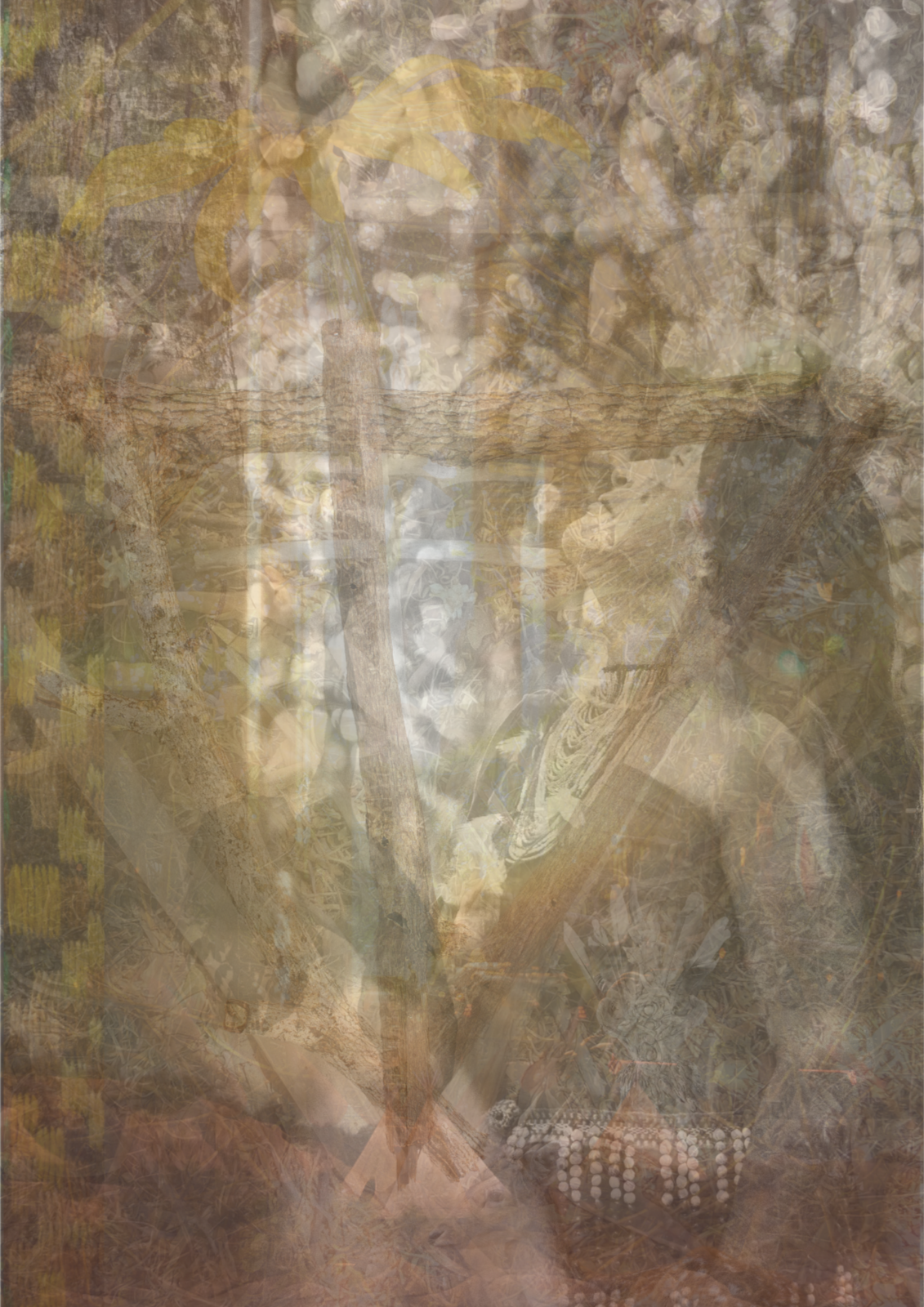
Ankira | Digital Collage by Kristie Ives (2024)
This is Ankira.
She first came to me in a vivid dream many years ago. The sort that feels like a visitation.
I remember an earthy, wise woman, scattered leaves, a symbol carved into the earth. Perhaps she drew it with a stick, or maybe the symbol itself was made from sticks. I honestly can’t remember now. That little detail has become blurry with time.
But what hasn’t faded is the symbol itself. I woke with a strong sense of its importance. I also had absolutely no idea what it meant.
So, of course, I Googled it. I searched through symbols and images, trying different words and descriptions, hoping I might find something that looked like what I had seen. I scoured through books and wisdom traditions. I showed it to family and friends. All to no avail.
I drew the symbol again and again. I returned to the woman and the image through imaginal journeys. I journalled about her, asked questions, wondered who she was and what she might be trying to show me. At different times, words and associations arose — earth, embodiment, grounding, direction, anchor. Yet still I kept asking.
At one point I wondered whether the symbol was upside down. Perhaps I hadn’t rememebred it correctly. Yet whenever I tried to change the orientation my hands wouldn’t comply.
A few years later, following an art therapy session in which this dream fragment reappeared, I decided to physically make it. I went home into the garden and gathered sticks. Some were straight; others were pale, almost bone-like or chalky. It felt right somehow, recreating it on the earth, a backdrop of leaves at my feet, dappled light from above, echoing the dream in this way too. And as I did this, new associations began to emerge — arrow, flint and bone. Body. Anchoring spirit into the earth.
The image was no longer simply something I had seen in a dream. It was embodied, made real on the earth.
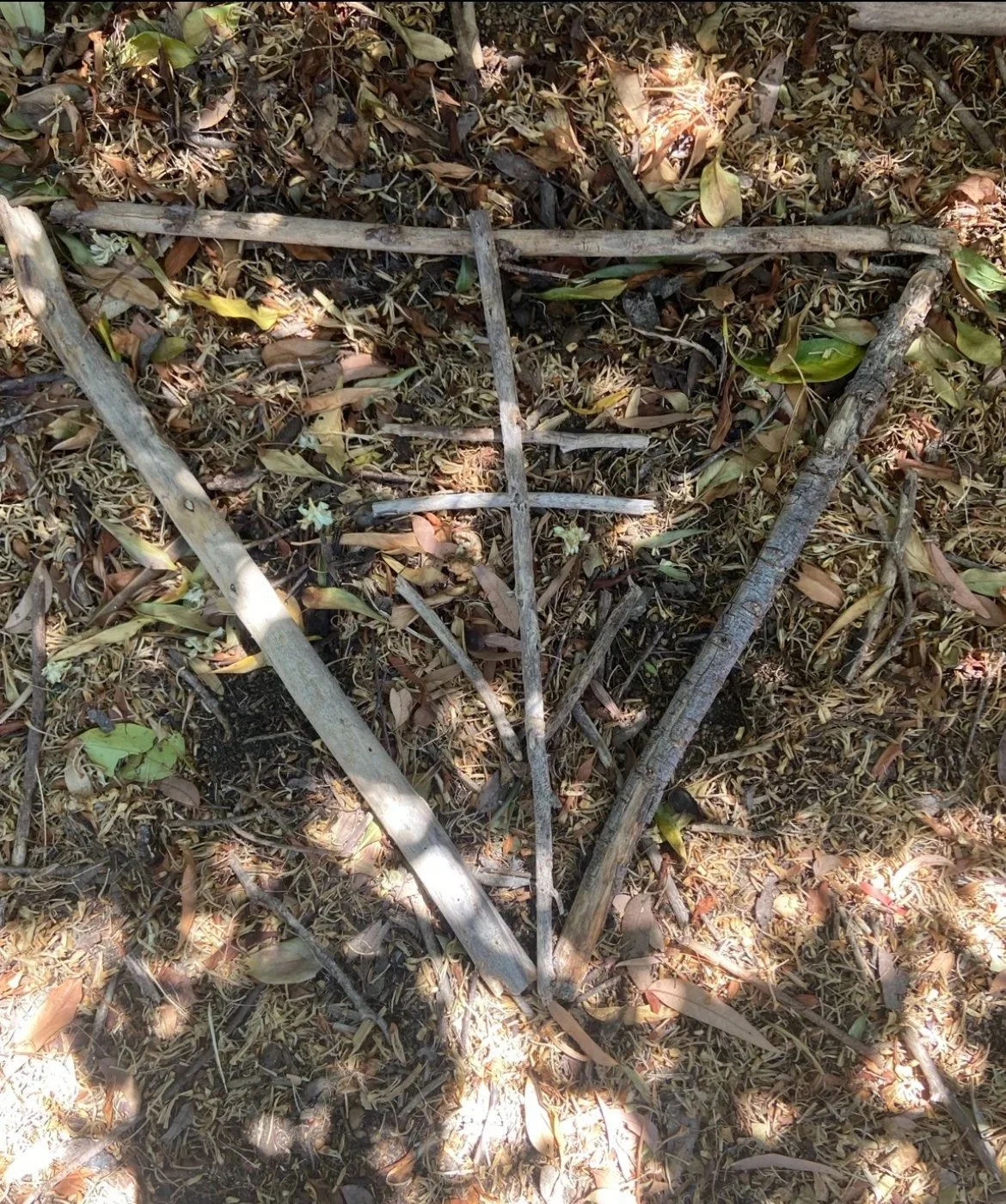
Dream Symbol recreated with sticks (2024)
Staying with the image
Looking back through those old journals now, I’m struck not only by the meanings I was finding, but by how determined I was to find the meaning. I wanted to know definitively what the symbol was. Interestingly, I largely ignored exploring the dream woman, and a lot of the surrounding aspects of the dream. There was a single-mindedness to my approach.
Years later, as I was studying Transpersonal Therapy, I was introduced to the work of archetypal psychologist James Hillman, and his invitation to “stick to the image.”
Hillman cautioned against moving too quickly from an image into an interpretation of it. When we decide that an image or symbol means one particular thing, we may make it more understandable, but we can also narrow it — leaving behind the richness and multiplicity of the image itself. In writing about a dream of a frightening black dog, Hillman resists reducing the dog to a single symbolic meaning. To paraphrase the spirit of his approach: perhaps it’s better to have the big black dog by your side all day than to know what he means.
I found something deeply freeing in this. Perhaps I never needed to “solve” Ankira. The words that arose over the years — earth, embodiment, anchor, direction — didn’t have to become set in stone answers. They could simply become part of an ongoing conversation.
Stick became bone.
Bone became body.
The downward arrow became anchoring and direction.
The triangle became earth.
The dream image became an object made with my hands and laid upon the ground.
One image opened into another and the relationship continued.
Companioning an image
This, I’ve since come to understand, is companioning. Rather than extracting meaning from an image, we allow ourselves to develop a relationship with it. We might draw it. Write alongside it. Dream with it. Meditate with it. Make it in another form. Put it somewhere we will encounter it and notice what happens when we meet it again.
Or we might simply allow it to remain. Because our relationship with an image doesn’t have to stay still either. Ankira hasn’t.
She has moved from dream to drawing, from drawing into imaginal exploration, from imagination into sticks gathered from the earth, and eventually into my digital collage practice.
She has shapeshifted.
And I have been different each time I have met her.
For a long time, I experienced Ankira as someone other — perhaps a guide, an ancestral or spiritual figure, someone who had appeared to give me something I was supposed to understand. Only much later did another possibility begin to emerge.. What if she wasn’t only other? What if she was also me?
I began to recognise something in her — what I came to understand as a transpersonal, shamanic aspect of myself that perhaps I didn’t yet have the language or capacity to recognise when she first appeared.
And even now, I don’t think that means I’ve finally worked out what the Ankira dream “means.” She, along with her symbol, still feels alive. There are still things I don’t understand. There may be things I understand differently in another ten years. Perhaps that is part of what it means to stay in relationship with an image.
When the time is right
Recently I encountered an idea from Tibetan Buddhism that spoke to me deeply.
Within the Tibetan Buddhist tradition there is a concept known as terma, or treasure — sacred teachings understood to have been concealed and later revealed when the appropriate conditions arise. These include physical treasures and what are described as “mind treasures”, revealed within the consciousness of particular practitioners known as tertöns.
I don’t mean to suggest an equivalence between terma and my own creative or imaginal practice. What caught me was something much simpler:
the possibility of something being present before the time has come for it to be revealed.
It made me think again about Ankira. Perhaps an image can sometimes give form to something that has not yet become available to conscious knowing. Perhaps sometimes the task is simply to notice it.
To give it form.
To keep it close.
And to allow time to participate in its revealing.
To allow it to shapeshift, even.
Not necessarily because there is one fixed meaning concealed inside it, waiting for us eventually to discover the correct answer, but because we are changing too.
There is something about this that reminds me of a much more ordinary pattern in my life. I have a tendency to buy books that call to me, put them on my bookshelf — and then not read them. Sometimes for years. Then one day I notice one again. I take it down and begin reading, only to find myself wondering how I could possibly not have read it earlier. The Celestine Prophecy was like this for me. Earth was another. Neither held me when I felt picked them up, yet I devoured them years later. The words in the book haven’t changed. But I have. My experiences have changed. The questions I am living have changed. Something I might once have skimmed over suddenly has somewhere to land. Sometimes it seems as though I acquired the book long before I was ready to receive what I would eventually find in it. And I can’t help wondering about all the unread books still sitting on my shelves. Perhaps there is one there now, quietly waiting for me to hear its calling. Perhaps images can be like this too.
Receiving, making, companioning
As I reflect on my relationship with Ankira, I realise that it also gives language to something that has gradually become central to my own creative practice and to the Soul Card Circles I facilitate.
I can see three interconnected movements within it:
Receiving.
Noticing what calls to us — an image, colour, word, texture or fragment — without immediately needing to know why.
Making.
Giving what has called to us form. Bringing images and fragments into relationship, following intuition and allowing something to emerge without determining in advance what it should become.
Companioning.
Remaining in relationship with what has appeared.
Sometimes meaning comes during the making. Sometimes something becomes apparent when we return to an image days or months later. Sometimes the image shapeshifts through another dream, another artwork, another experience or another stage of our lives. Sometimes it joins other images we have made, and recurring figures, landscapes, symbols or archetypal threads gradually become visible. Images that once seemed unrelated may begin to speak to one another, forming something like a personal symbolic language across time.
Together, they may begin to reveal a larger story — one that no single image could have told on its own.
And sometimes we simply don’t know.
There is room for that too.
Allowing mystery to remain
Perhaps this is one of the gifts of working with image. It asks something different of us than explanation. Not everything arising from the deeper layers of psyche needs to be immediately translated into words or made coherent by the conscious mind. An image can matter without being fully explainable. It can accompany us without giving us an answer. It can shapeshift as we do. It can disappear from our attention and return years later, newly alive. And sometimes an image we have carried quietly for years reveals something that makes us realise it may have been holding far more than we were capable of recognising when it first appeared.
Perhaps some images arrive before understanding.
Perhaps some meanings can only emerge through relationship.
And perhaps our task isn’t always to decipher what has appeared.
Sometimes it may be enough to notice it. To give it somewhere to live. And to stay curious about what it may yet reveal.